How Korea's 2027 Token Securities Plan Fits Together
Key Takeaways
- Korea has already changed its laws. The new token securities rules take effect on February 4, 2027. The September plan shows how they will run, and it is easiest to read in four parts.
- Same securities, new container. There is no special license for token securities. Whether something is a security, and whether it can be held as a token, are answered by two different laws.
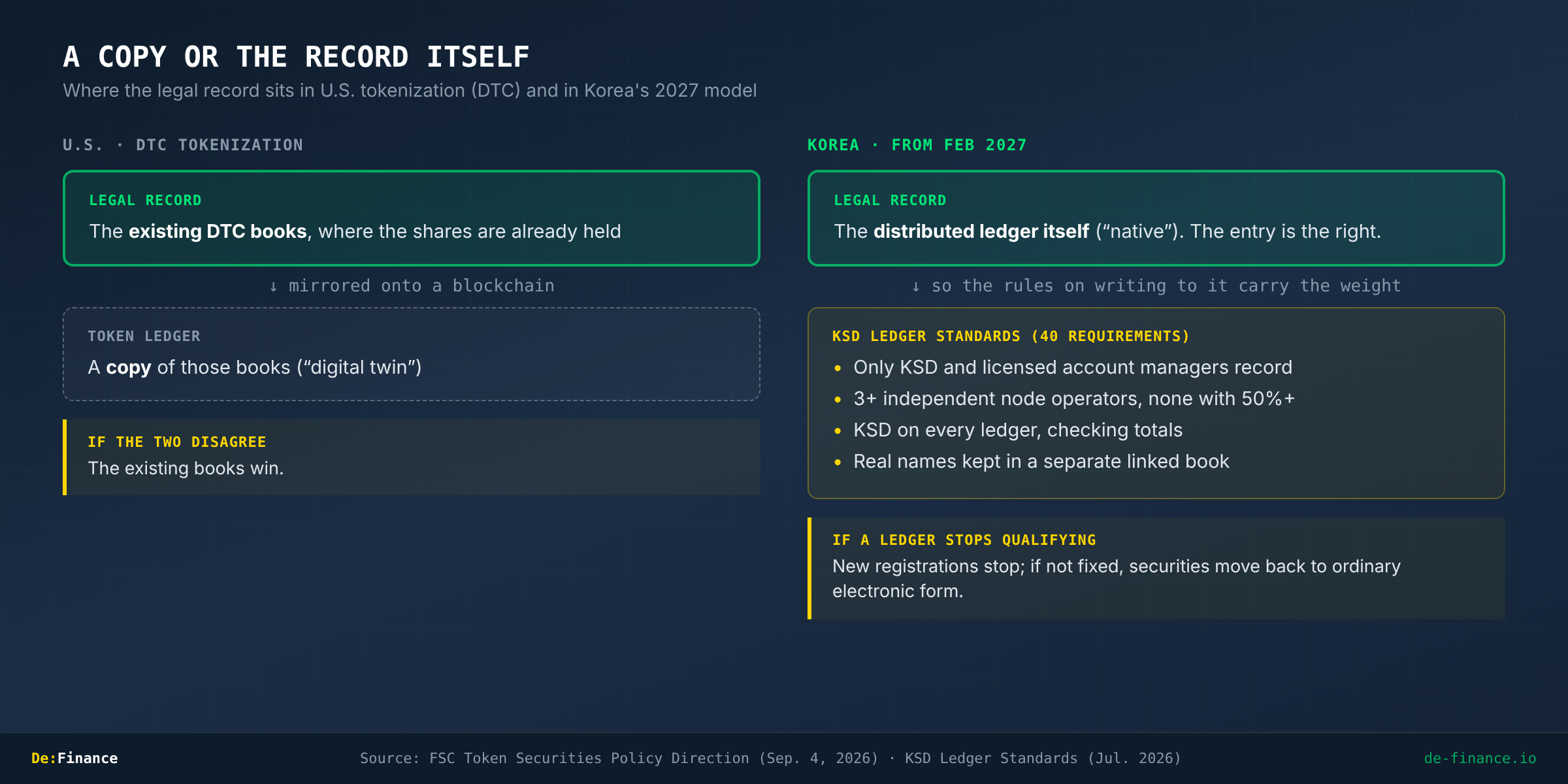
- The ledger is the legal record. This is the biggest difference from tokenization in the U.S., and it is why the rules on who can write to the ledger carry so much weight.
- Start where risk is lowest. On day one, most retail investors will notice little change.
- Trading happens on capped off-exchange venues. Retail investors can make up to KRW 100 million in net purchases a year on each venue.
Why this matters
On September 4, 2026, Korea's Financial Services Commission (FSC) published its full token securities plan at the third meeting of its public-private council. It came with a code of practice for fractional investments and the technical standards for ledgers set by the Korea Securities Depository (KSD). Five draft decrees based on the plan followed on October 2, with public comments due November 11. This is the most complete picture the market has before the February 2027 start. The broad frame continues the government's February 2023 plan; what is new is the order in which things open and the actual numbers.
1. Same securities, new container
The plan sorts securities along two lines. What a security promises (its content) is governed by the Financial Investment Services and Capital Markets Act. This is where the familiar types sit: bonds, shares, trust beneficiary certificates and investment contract securities. What form it takes (its container) is governed by the Electronic Securities Act: paper, electronic, or token.
A token security is a question of form. Its legal nature, and the legal effect of recording it, are the same as for an ordinary electronic security.
Two things follow from this.
First, there is no token-only license. Korean licenses are defined by what a security is, not by its form. A firm licensed to broker shares can broker those shares when they are tokens.
Second, two questions get answered by two different laws. "Is this a security?" is a capital markets question. "Can this security be held as a token?" is an electronic securities question. Putting something on a blockchain does not make it a security, and it does not take it out of securities law either. Discussions abroad often blend the two questions into one sentence. Korean law separated them from the start.
The account structure also stays the same. KSD keeps the accounts of brokers and other account managers, and those firms keep their customers' accounts. What changes is how the books are written. Today each institution keeps its own book. With token securities, KSD and the brokers run nodes and record on the same ledger together.
2. The ledger is the legal record
The plan itself spells out how Korea differs from the U.S. In the tokenization service of the Depository Trust Company (DTC), listed shares already held at DTC are mirrored onto a blockchain as tokens. That ledger is not the final legal record. It works more like a copy of the existing books (a "digital twin"). In Korea, the distributed ledger itself is the legally effective record (a "native" model). The plan places Hong Kong's tokenized green bonds on the same side as Korea.
This difference goes further than it first looks. In a copy model, if the token ledger and the official books disagree, the official books win. In Korea's model, the ledger entry is the right itself. So the rules on who may write to the ledger, and when an entry becomes final, carry the weight that the traditional books carry in the U.S.
That explains why KSD's ledger standards run to 40 detailed requirements. A ledger built by brokers must pass a document review and connection testing before it can link to KSD's system. Four rules stand out.
- Who writes: Only KSD and licensed account managers can record on the ledger. Firms that only provide the network technology are not restricted.
- How spread out: At least three independent institutions must run consensus nodes, and no single institution may hold 50% or more of the nodes.
- Who checks the totals: KSD runs a node on every ledger and makes sure the amount issued always equals the amount in circulation.
- What stays off the ledger: Real names and other personal data are kept in a separate linked book, not on the ledger itself.
If a ledger later stops meeting these rules, new registrations stop. If it cannot recover, its securities are converted back to ordinary electronic securities. Because the ledger is the legal record, rights cannot stay on a ledger that no longer qualifies.
3. Start where risk is lowest
The plan says building everything at once would be costly and less stable, so it opens in three stages.
| Stage | What gets tokenized | Settlement |
|---|---|---|
| 1 (Feb 2027) | Private money market funds and private bonds for institutions only; unlisted shares through a trust | Cash, existing systems |
| 2 (no date) | Public offerings and more | Cash, existing systems |
| 3 (after stablecoin law) | On-chain settlement | Stablecoins and similar |
The private bonds in stage 1 are plain bonds that pay interest and principal; bonds that convert into shares are left out. Unlisted shares are not tokenized directly. The shares are placed in trust with KSD or a trust company, and the trust certificates are issued as tokens. Shareholder rights such as voting stay in the existing electronic system.
Read from a retail investor's seat, February 4, 2027 will not feel like a big change. The fund and bond products are for institutions. Unlisted shares come in indirectly, as trust certificates. Settlement stays in cash on today's systems. What retail investors will actually meet are the fractional investment venues, and those are mostly a market that already ran under a regulatory sandbox now moving into the formal rules. It is true that "Korea's token securities market opens next year," but this is the size of year one.
Stage 2 has no date. The plan ties it to when a network can reliably handle accounts and rights for large numbers of investors. Stage 3 depends on stablecoin legislation. Separately, the Korea Exchange will run model testing and a pilot for tokenizing listed shares.
4. Capped off-exchange venues, not exchanges
Token securities will trade on off-exchange trading venues, which differ from a stock exchange. They need a lighter license, a minimum capital of KRW 6 billion, and trades only execute when a buy price and a sell price match exactly. Investors sign up with the venue directly, without going through a broker. Two fractional investment venues received preliminary approval in February 2026.
Retail investors can make up to KRW 100 million a year in net purchases (purchases minus sales) on each venue. The plan cites two reference points: the US$100,000 annual cap used when U.S. crowdfunding began, and Korea's old KRW 100 million minimum for private funds. The domestic comparison it gives is crowdfunding, capped at KRW 5 million per deal and KRW 10 million in total. The new cap sits much closer to the U.S. crowdfunding figure than to Korea's own crowdfunding limits.
The plan also creates a new license category for venues that trade bonds with retail investors. It is not meant for immediate licensing; it prepares for publicly offered token bonds later. Trading in investment contract securities (Korea's §4⑥) will be considered after a study on how to make them tradable.
Fractional investments also got a code of practice. It conditionally allows pooling similar assets into one product, and using assets that do not exist yet, such as future sales receivables. Whoever places the asset in trust must keep at least 5% of the certificates until the trust ends.
Questions still open
- What triggers stage 2? The plan says only that it will come sooner if the networks are ready sooner. Who decides, and by what test, is not yet set.
- How will stablecoin settlement connect? The plan lists both bridging institutions and direct technical links between the token ledger and a stablecoin ledger as options. Korea's digital asset framework law has to come first.
- What will the investment contract study conclude? The plan itself notes that, for co-ownership products, moving the token between accounts does not fully complete the transfer.
Timeline
| Date | Event |
|---|---|
| Sep 4, 2026 | Full plan published (council's third meeting) |
| Oct 2, 2026 | Five draft decrees published for comment |
| Nov 11, 2026 | Comment deadline |
| Feb 4, 2027 | Amended laws take effect; stage 1 begins |
The next post looks at how the October draft decrees turn this plan into rule text.
Sources
- Financial Services Commission, press release "Token Securities Policy Direction" with three attachments (Sep. 4, 2026)
- Financial Services Commission, "Token Securities Issuance and Distribution Framework" (Feb. 2023)
- Korea Securities Depository, "Token Securities Distributed Ledger Standard Requirements Guideline" (Jul. 2026)
- Financial Services Commission, Notices No. 2026-667 to 2026-671 (draft decrees, Oct. 2, 2026)