After the Rulebook — What the SEC Proposed in Regulation Crypto Assets
Series: The New Crypto Rulebook — Decoding SEC Release 33-11412 · Part 5 (final)
Key Takeaways
- The SEC has proposed Regulation Crypto Assets, a new rulebook for raising money by selling tokens in the United States.
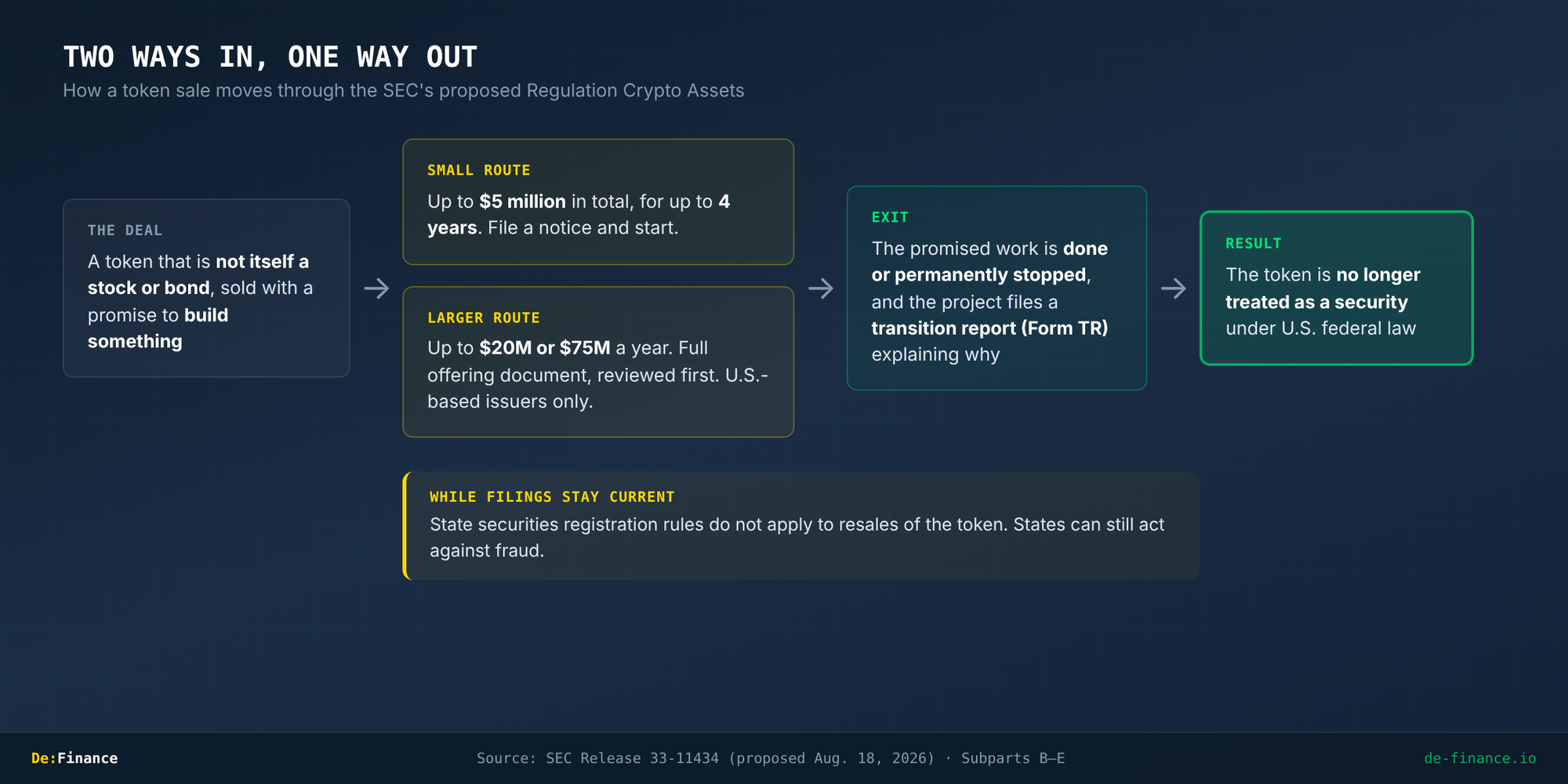
- It gives projects two ways to sell tokens without a full securities registration: a small, simple route (up to $5 million) and a larger route (up to $20 million or $75 million a year).
- It also gives projects a way to say "our token is no longer a security": file a report showing that the work they promised buyers is done.
- It does not cover tokenized stocks or bonds. Those are handled separately.
- Public comments close on October 20, 2026. The rule can still change.
Why this matters
Earlier in this series we looked at the SEC's March 2026 guidance (Release 33-11412). That guidance answered a question the crypto industry had argued about for years: when is buying a token really buying into someone else's business, and when does that stop?
The guidance gave answers, but no procedure. A project could not file anything to prove where it stood. On August 18, 2026, the SEC proposed one (Release 33-11434). This post walks through it in plain terms.
1. Which tokens it is about
The rule is about one kind of deal: you buy a token, the token itself is not a stock or a bond, but the people selling it promise to build something that will make it worth more. In U.S. law that promise is what turns the deal into an "investment contract," and investment contracts are regulated as securities.
So the rule is aimed at the promise around the token, not at tokens that are securities by nature. A tokenized share of a company is still a share, and this rule does not apply to it. (The SEC dealt with trading venues for tokenized securities separately, in a September 17, 2026 exemptive order.)
One detail worth knowing: the rule counts airdrops and rewards for running or securing a network as part of the token sale. Giving tokens away does not take a project outside the rules.
2. Two ways to sell tokens
| Small route | Larger route | |
|---|---|---|
| How much | Up to $5 million in total | $20M (Tier 1) or $75M (Tier 2) a year |
| How long | Up to 4 years | Ongoing; new filing after 3 years |
| What you file | A short notice before you start | Full offering document, reviewed first |
| Who can sell | Any company, person, or group (once per token) | U.S.-based companies only |
| Who can buy | No limits in the rule | Non-accredited buyers: up to 10% of income or net worth |
The small route (the SEC calls it the startup exemption) is built for early projects. There is no review step: the project files a notice, posts its disclosures on a website, and can start. It can only be used once for the same token.
The larger route (the fundraising exemption) looks more like a traditional offering. The company must be organized in the U.S., with most of its leadership, assets, and operations there. Bigger raises (Tier 2) need audited financial statements, and the company files annual, semiannual, and event reports.
3. What projects have to tell buyers
Both routes require the same kind of disclosure, written in plain language and kept consistent with what the project already says on its website and social media. The list covers what you would want to know before buying:
- what the team has promised to build, and how far along it is
- how much money is being raised and what it is for
- who is behind the project and any conflicts of interest
- how the network and its code work, and whether the code is public
- tokenomics: total supply, how much insiders hold, and when locked tokens unlock
- who controls upgrades and settings
- risks specific to this project, not boilerplate
4. How a token stops being a security
This is the part the industry has waited for. Under the proposal, the investment contract ends when two things are true:
- the project has finished, or permanently stopped, all the key work it promised buyers, and is not making new promises; and
- it files a transition report (Form TR) explaining, clearly enough for an ordinary investor to follow, why that is the case.
What counts as "finished"? The SEC's explanation points to a working network. Once the network actually works, ongoing maintenance, security, and upgrades no longer count as the kind of work that keeps the token a security. Before the network works, the same activity probably does.
A few things the rule does not ask for: a measurement of how "decentralized" the network is, a waiting period, or approval from the SEC or an auditor. The project certifies it itself. The trade-off is risk: if the report turns out to be wrong, the SEC can treat the investment contract as still in place, with the securities rules still applying.
5. Trading after the sale
In the U.S., each state also has its own securities rules. The proposal would switch those state registration rules off for resales of these tokens, as long as the project keeps its required filings up to date. States can still go after fraud.
6. What it means if you are looking at Korea
Two facts are useful for teams that also deal with Korea:
- Korea's new token securities law, taking effect in February 2027, covers tokens that are securities, such as tokenized shares and bonds. It does not cover the kind of token this U.S. rule is about.
- Korean law has no filing like Form TR that lets a token leave securities status. A token sold under the U.S. small route would still be assessed on its own terms under Korea's investment contract rule (Article 4(6) of the Financial Investment Services and Capital Markets Act).
Wrapping up the series
This series began with the SEC's March guidance on how to classify tokens. Regulation Crypto Assets turns that guidance into steps a project can actually take: a way to raise money, and a way out. It is still a proposal, and the SEC's chairman has said that lasting rules will need legislation from Congress as well.
This is the final post in the series. Korean developments will continue on De:Finance.
Sources
- SEC, Regulation Crypto Assets (proposed rule), Release Nos. 33-11434 / 34-106150 — sec.gov
- Federal Register, Doc. 2026-17183 (Aug. 21, 2026) — federalregister.gov
- SEC, Fact Sheet — sec.gov
- Statement of Chairman Paul S. Atkins (Aug. 18, 2026) — sec.gov
- SEC, Release 33-11412 (Mar. 17, 2026) — sec.gov
This article is Part 5, the final part, of "The New Crypto Rulebook" series. For Part 4, see When Lifecycle Meets 투자계약증권.